Blog
Better data, bigger impact: Why data aggregation matters
Financial Institutions: Data-Driven Marketing, Market Your Business
 4 Minutes
4 Minutes

Better data drives smarter marketing. Quality data can be a major factor in a campaign’s success, as the difference between a hit and a miss often comes down to how quickly and accurately marketers can connect the dots. For brands serious about performance, having a complete picture of who your customer is means everything.
When it comes to data sources, what sets good apart from great relies on scale and intelligence. According to Kristopher Lazzaretti, SVP President of Data at Deluxe, the right blend of technology, large-scale aggregation and AI-powered optimization is necessary to unlock meaningful results.
“Aggregation addresses this directly by gathering, consolidating and organizing information from various sources to build richer, more complete views of consumers and small businesses,” he explains. “The difference is moving from a narrow snapshot to something closer to a complete picture.”
The problem with single-source data
Sourcing insights from one third-party provider might be the easiest route to take, but it is less likely to give you the full picture. Existing and potential customers don’t spend all their money in one place, and what influences that spend is also non-linear. Even the identity under which they spend (name, address, phone number, etc.) might differ from purchase to purchase.
“Single-source data simply cannot capture all the meaningful consumer and small businesses insights required to run effective marketing campaigns,” explains Lazzaretti. No matter how powerful the tool used to translate that data into messaging is, if the data is thin, the results could end up that way, too.
That’s where data aggregation comes in.
What is data aggregation, and why does it matter?
Data aggregation is the practice of gathering, consolidating and organizing information from various data sources. This process allows organizations to build a richer, more complete view of a prospect by drawing insights from multiple angles, like life events, behaviors, preferences and transactions.
“A key differentiator of our business is that we aggregate data from well over 100 sources, [resulting in] billions of different insights about consumers and small businesses,” Lazzaretti shares. He also notes that there are four key areas where data aggregation can translate into performance, namely:
1. Coverage
Single-source data can have blind spots, but aggregated data provides better visibility. For some data types, Lazzaretti explains that “coverage can improve marketing materiality by a factor of three to four times or more.”
2. Speed
Some purchasing decisions are made over days, some in just minutes, making timeliness one of the most important triggers in a marketing campaign. As Lazzaretti explains, without real-time decisioning, opportunities are lost at a compounding rate, especially when it comes to life-event trigger marketing.
“Our research across clients shows that the conversion value of trigger signals declines by more than 30 percent one week following the event, and it continues falling thereafter,” shares Lazzaretti.
3. Accuracy
When personalization gets it right, marketing feels natural. But when those details are wrong, the result can do more harm than good. Having a clear and accurate picture of the prospect or customer can make or break brand trust, and the more information you have, the clearer that picture becomes.
A key differentiator of our business is that we aggregate data from well over 100 sources, [resulting in] billions of different insights about consumers and small businesses.
— Kristopher Lazzaretti
SVP President, Data, Deluxe
According to Lazzaretti, “Accuracy improves when data points from multiple sources can be used to corroborate insights and sharpen analytics.”
4. Actionable insights
Basic informational data is one thing, but when layered with profiling information (think psychographic drivers, discretionary spending, cash flow patterns, etc.), that data is transformed into more actionable insights.
“The marketing benefit is even more significant,” Lazzaretti notes, “including richer segmentation, sharper targeting, and campaigns that reach the right people with messages that are relevant to them.”
Entity resolution: Turning duplicate data into complete customer profiles
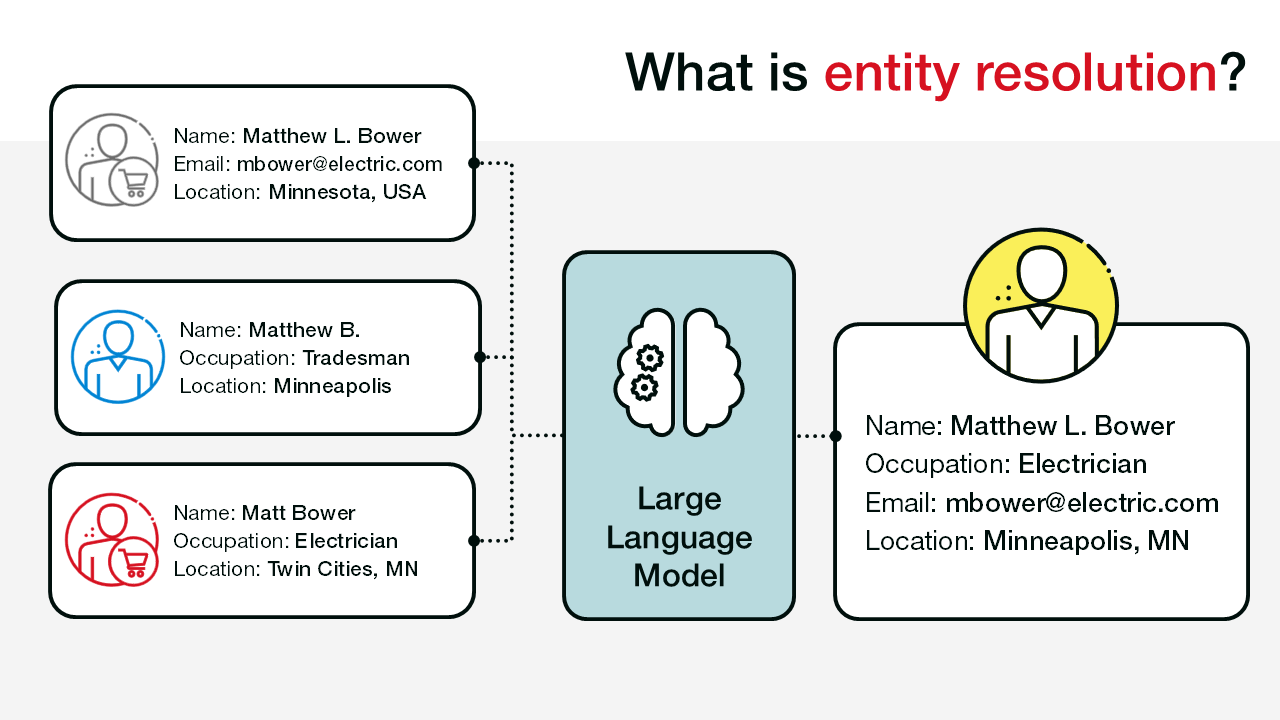
“A consumer or business can represent their name, address or digital identifiers in almost an unlimited number of ways,” Lazzaretti explains. “What our large language model does is help us reconcile all of those different representations of names and addresses and understand where the same consumer is represented across multiple databases.”
This process, called entity resolution, is critical for accurate targeting and personalization; and AI has made it significantly faster, efficient and more scalable. Aggregated data alone is powerful, but it’s AI that makes it agile.
“We are streamlining our processes and removing all of the undifferentiated heavy lifting by using leading-edge AI capabilities to remove manual effort,” says Lazzaretti. “Now our team gets more time to spend supporting our customers and delivering on their business objectives.”
By reducing manual data cleansing and list hygiene tasks, AI enables marketing teams to operate faster without sacrificing quality. That speed translates directly to potential results.
Cleaner data = bigger opportunity
The aggregated data file offered by Deluxe is about four times larger than that of competitors in the market. Size isn’t the only advantage; it’s how that data is cleaned and sorted that makes it actionable.
Once the data is aggregated, the system removes underperforming records, de-duplicates entries and optimizes the list. This results in fewer blind spots, more callable leads and better overall campaign efficiency.
In marketing, a few days can make all the difference. Super aggregated data allows brands to close that gap. With faster, more actionable insights, you can get your message in front of the right people at the right time with the right message.
Read more of Kristopher Lazzaretti’s thoughts on data aggregation in this Financial Brand article.
Smarter data, stronger results
See how our data-driven trigger marketing solutions can help give you an edge in the market.
RECOMMENDED RESOURCES


